The sagas crackle with tales of Viking expeditions to a new world, and the archaeological site at L’Anse aux Meadows in Newfoundland stands as undeniable proof of their North American presence a full millennium ago. Yet, even with these tantalizing literary threads and the solidity of stone and soil at L’Anse aux Meadows, the story of Norse Vinland is far from complete. This history whispers with unanswered questions, a vast mosaic with crucial pieces lost to time or perhaps, yet to be unearthed. This incompleteness is precisely what fascinates, drawing us towards the hazy edges of the known world, beckoning us to gaze deeper into the northern mists.
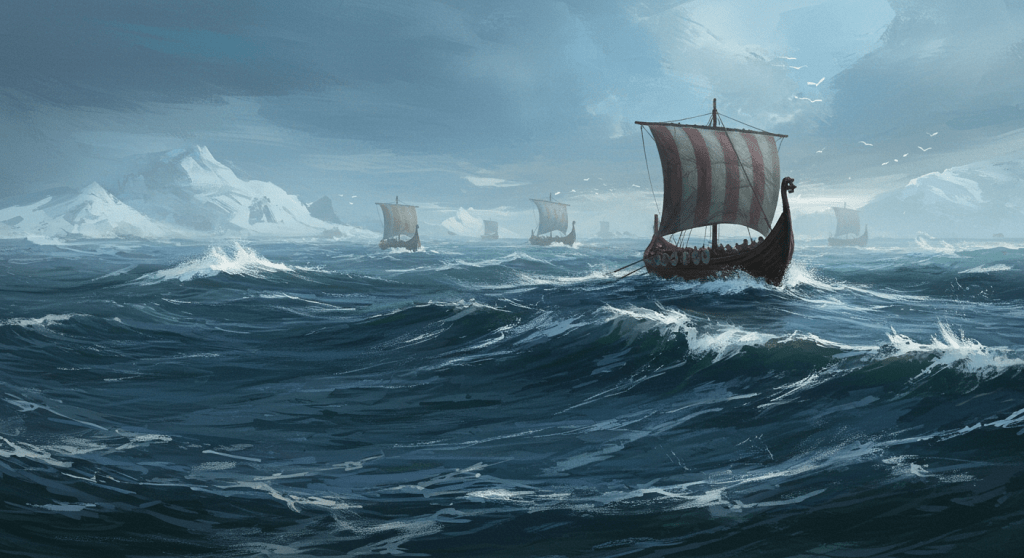
The Saga Itineraries: Charting a Course Through Narrative
Long before shovels scraped against the foundations of forgotten halls, the Icelandic Sagas—primarily the Grænlendinga saga (Saga of the Greenlanders) and Eiríks saga rauða (Saga of Erik the Red)—were our only flickering lights into these audacious western voyages. These accounts, painstakingly inked into vellum generations, even centuries, after the echoes of oar-splash and battle-cry faded, paint vivid, often haunting, pictures of the lands they claimed to have found. Yet, their chronicles often clash, weaving further complexities into an already shadowed history.
But how much of these epic tales can we trust? What truths lie hidden beneath the poetic license, and what genuine memories of a vast, strange land still resonate within those ancient verses?
According to the Saga of the Greenlanders:
- Bjarni Herjólfsson’s Accidental Sighting (c. 985-986 CE): Blown off course en route to Greenland, Bjarni is credited with the first European sightings of North America. He saw three lands: the first wooded and hilly, the second flat and wooded, and the third mountainous and glaciated, but, for reasons lost to us, he chose not to set foot on these new shores.
- Leif Eriksson’s Purposeful Expedition (c. 1000 CE): Intrigued by Bjarni’s report, Leif bought his ship and retraced the route in reverse.
- Helluland (“Land of Flat Stones” or “Stone-Slab Land”): The first land Leif encountered, corresponding to Bjarni’s last-seen land. It was barren, glacier-covered, and dismissed as worthless, a desolate expanse at the world’s edge. The howl of the wind across a desolate Helluland must have been a chilling welcome.
- Markland (“Forest Land”): Sailing south, they reached a flat, wooded land, valued for its timber. One can almost smell the scent of pine in Markland.
- Vinland (“Wine Land”): Further south, they found a hospitable region where they built large houses called Leifsbúðir (“Leif’s Booths”). The name Vinland came from the discovery of wild grapes by Leif’s foster-father, Tyrker.
- Subsequent Voyages: The saga details further expeditions to Vinland based at Leifsbúðir, including one led by Leif’s brother Thorvald Eriksson, who explored further and met his end in a violent clash with the native inhabitants, the Skrælings—a name whose own origins are debated. Another brother, Thorstein Eriksson, attempted a voyage with his wife Gudrid Thorbjarnardóttir to retrieve Thorvald’s body but was storm-tossed and never reached Vinland. Later, Thorfinn Karlsefni, who married Gudrid, led a major colonization attempt with around 60 men and 5 women, lasting about three years, during which their son Snorri Thorfinnsson was born. A fragile peace and initial trade with the Skrælings inevitably fractured, descending into bloodshed that ultimately forced the hopeful colonists to abandon their precarious foothold. What anxieties or grim realizations prompted such a drastic step beyond just conflict? The final, bloody expedition was led by Leif’s sister, Freydís Eiríksdóttir.
According to the Saga of Erik the Red:
- Leif Eriksson’s Accidental Discovery: This saga attributes the accidental discovery of Vinland directly to Leif. While sailing from Norway to introduce Christianity to Greenland, he was blown off course and found a land with self-sown wheat, vines, and maple trees (mösurr).
- Thorfinn Karlsefni’s Major Expedition: This saga, however, charts a somewhat different, yet equally compelling, course through these events, consolidating the main exploratory and settlement efforts under Thorfinn Karlsefni and Gudrid. Their large expedition (perhaps 160 people) also sailed to lands they named:
- Helluland: A land of large stone slabs and many foxes.
- Markland: A wooded land.
- Kjalarnes (“Keel Ness”): A promontory where they found the keel of a ship.
- Straumfjörðr (“Fjord of Currents”): Their primary northern base in a mountainous country with an island full of birds at the fjord’s mouth. They overwintered here, facing a harsh winter.
- Hóp (“Tidal River” or “Tidal Estuary Lagoon”): Sailing south from Straumfjörðr, they found this richer area where a river flowed through a lake to the sea. It was abundant in wild wheat, grapes, and fish, with a reportedly mild winter (no snow). It was at Hóp that significant trade and conflict with the Skrælings occurred. Thorvald Eriksson is also part of this expedition and is slain by a creature the saga cryptically describes as a ‘uniped’—a one-legged being, a chilling detail that blurs the line between chronicle and nightmare.
- Abandonment: Increasing dissension and the ongoing threat from the Skrælings led Karlsefni’s expedition to abandon Vinland and return to Greenland/Iceland.
These differing accounts—who discovered Vinland first, the organization of expeditions, and the names and descriptions of settlements—highlight the challenges in using the sagas as direct historical blueprints.
The Shifting Sands of Saga Landscapes: Where Exactly Was Vinland?
One of the most haunting and persistent questions is how to anchor these saga-spun landscapes to the solid earth we know today. While there’s broad scholarly consensus that Helluland likely corresponds to Baffin Island and Markland to the forested coasts of Labrador, the true reach, the very heart of Vinland, remains shrouded in scholarly debate and tantalizing speculation.
The sagas speak of distinct settlements within Vinland, such as Leifsbúðir, Straumfjörðr, and Hóp. L’Anse aux Meadows itself has been interpreted by some as Leifsbúðir from the Saga of the Greenlanders. However, a more widely accepted theory, championed by archaeologist Birgitta Wallace, suggests it was Straumfjörðr from Eiríks saga rauða—a strategic northern base. If L’Anse aux Meadows was this northern sentinel of Straumfjörðr, then where did the sagas’ Hóp truly lie—that almost mythical land of wild grapes, gentle winters, and flowing rivers? Wallace has proposed areas like the Miramichi-Chaleur Bay region of northeastern New Brunswick as a strong candidate for Hóp, a region matching descriptions of wild grapes, self-sown wheat (possibly lyme-grass or wild rice), salmon, and a milder climate.
Vinland was likely a larger region rather than a single point, encompassing various ecological zones explored by the Norse. The names themselves—Helluland denoting uselessness for settlement, Markland signaling a vital resource (timber), and Vinland promising abundance and even luxury items like wine—were less precise pins on a map and more echoes of hope, ambition, or perhaps even warnings, reflecting the Norse worldview as they faced an immense, unknown continent. To trace their ghostly footsteps across this sprawling, ancient landscape is a formidable, perhaps even impossible, task.
Beyond L’Anse aux Meadows: How Far Did the Norse Explore?
The discovery of butternuts (a type of walnut) at L’Anse aux Meadows is a small, yet potent, clue hinting that the Norse tendrils reached far deeper into the continent than L’Anse aux Meadows alone would suggest. Butternuts are not native to Newfoundland but grow in regions further south, such as New Brunswick. This strongly indicates that the occupants of L’Anse aux Meadows undertook voyages deep into the Gulf of St. Lawrence, the area often equated with the wider “Vinland” where grapes were also found.
Yet, the true boundaries of their journeys—how far south, west, or even north their longships sliced through uncharted waters—remain lost in the silence of centuries. Were there other temporary camps or specialized resource-gathering sites yet to be discovered? What silent, overgrown ruins might still await discovery in the deep woods or along forgotten coastlines? The unnerving silence of the deep forests beyond the settlements must have played on their minds. The search persists for any fragment, any whisper from the soil, that might illuminate the breathtaking, perhaps terrifying, scope of their North American sojourns.
The “Skrælings”: Unraveling Complex Indigenous Encounters
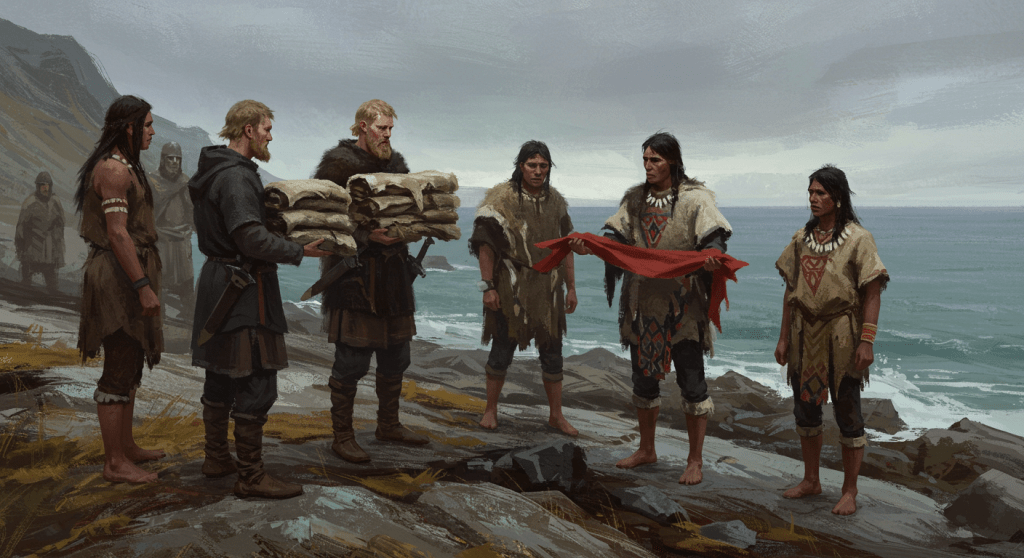
The sagas describe encounters, both peaceful and violent, with the Indigenous peoples the Norse collectively termed “Skrælingjar” or “Skrælings“. This single, somewhat dismissive term, however, undoubtedly veils a complex tapestry of diverse Indigenous nations and cultures, each with their own histories and territories. The Norse would have encountered different groups across the vast expanse from Helluland to the southern reaches of Vinland, potentially including the ancestors of the Beothuk or Mi’kmaq in Newfoundland and the Maritimes, the Dorset people in Labrador and Baffin Island, and the Thule Inuit (ancestors of modern Inuit). The true nature of these fleeting encounters likely shifted dramatically, a dance of curiosity, commerce, and deadly conflict, depending on the specific peoples and personalities involved.
Archaeologically, evidence of direct Norse-Indigenous interaction is nuanced and often debated. At L’Anse aux Meadows itself, while Indigenous groups occupied the area before and after the Norse period, there’s no evidence of contemporaneous occupation or direct interaction at that specific site. This silence at L’Anse aux Meadows doesn’t necessarily contradict the sagas’ claims of contact; rather, it might hint that this site was but one lonely outpost, while the more dramatic, perhaps fateful, encounters played out in other, still unidentified, locales.
More compelling, though controversial, are the findings from regions further north, identified as Helluland. Archaeologist Patricia Sutherland posited artifacts from former Dorset Paleo-Eskimo sites on Baffin Island—such as spun yarn consistent with Norse practices, whetstones, and small pieces of smelted metal—as evidence of a more sustained, shadowy Norse presence and intricate trade networks with the Dorset people from the 11th to 14th centuries. However, these interpretations remain subjects of debate within the archaeological community. Isolated finds, like a Norse penny discovered at an Indigenous site in Maine (the Goddard site), only deepens the enigma, with uncertainty about whether it arrived via direct Norse contact or through Indigenous trade networks. The full, nuanced story of these meetings between worlds, the echoes of words exchanged and blows struck, the true impact upon both Vikings and Skrælings, is a fractured narrative still painstakingly, and perhaps incompletely, being pieced together from whispers and fragments.
Whispers from the Earth: Interpreting the Archaeological Clues
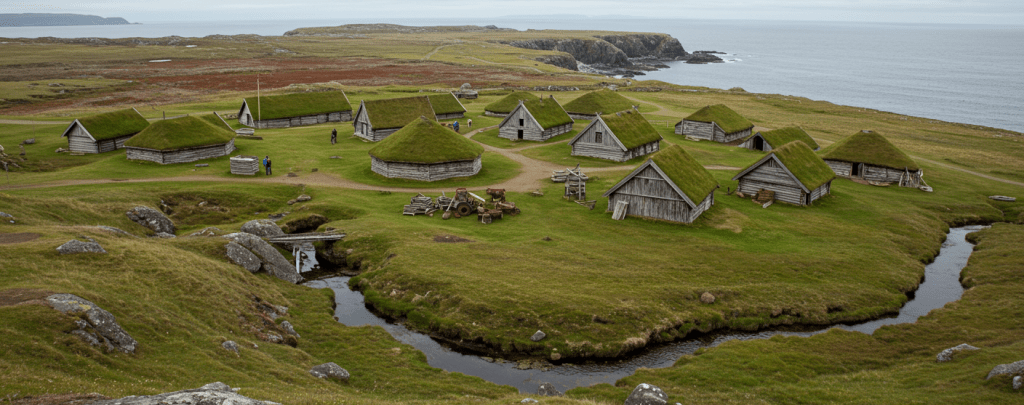
While L’Anse aux Meadows offers a wealth of information, the interpretation of its artifacts and even those from other potential contact sites continues to generate discussion. The precise duration of the occupation at L’Anse aux Meadows, generally considered short (perhaps a decade or two, with a precise wood felling date of 1021 CE), is still debated, with some outlier studies whispering of a more enduring, though perhaps more furtive, Norse tenancy. The function of every structure, the full range of activities, and the exact number of inhabitants remain areas of scholarly investigation.
Beyond the wind-lashed shores of L’Anse aux Meadows, the haunting scarcity of Norse artifacts across such an immense territory is itself one of Vinland’s most profound puzzles. Does this silence speak of fleeting visits, of men who trod lightly, leaving few scars on the land? Or does it hint at other sites, swallowed by forest and time, still awaiting an eye sharp enough, or lucky enough, to find them? Each new potential find, often a mere splinter of wood or a shard of rusted metal, surfaces from the earth shrouded in ambiguity, demanding painstaking analysis to distinguish it from later European colonial artifacts or items that may have moved through Indigenous trade.
The Vinland story, therefore, is one of constant re-evaluation as new research methods emerge and existing evidence is re-examined. The sagas provide the narrative framework, but archaeology offers the crucial, if sometimes cryptic, ground truth. These enduring enigmas ensure that Vinland will continue to haunt our historical imagination, its echoes whispering from the sagas and the very soil, compelling us to keep searching, keep questioning, for generations to come. Indeed, some far shores hold secrets that time, and perhaps the land itself, are reluctant to yield.


 C.M. Bell HQ
Leave a reply to C.M. Bell Cancel reply