by C.M. Bell
In the unforgiving landscape of 11th-century Greenland, Toki Sveinsson, a Norse poet, finds his settlement besieged by more than just a brutal winter. Strange patterns haunt his dreams, mirroring markings on ancient, unsettling stones uncovered by an earthquake—stones that seem to whisper of powers far older than the gods. As a mysterious sickness grips the settlers and food stores spoil, Toki realizes these “shifting runes” are not mere carvings but keys to a horrifying truth. The very land they inhabit is a prison for entities of cosmic scale, and as these beings begin to stir, Toki’s own daughter falls under their influence. With his people succumbing to an ancient horror and the markings appearing on his own skin, Toki must delve into forbidden knowledge to understand the chilling connection between his visions, the stones, and the looming catastrophe. But will he uncover the secrets in time, or will he become another victim of the whispers from beneath the ice?
I, Toki Sveinsson, a poet to those who once valued my craft, set these words upon vellum so some fragment of truth might survive. My hand trembles as I scratch this passage, for the markings coiling up my wrists have reached my elbows now. Soon they will claim my mind, as they have claimed so many others.
The cold has been our enemy since we first settled this barren shore. Eight winters have I endured in Greenland, each harsher than the last. This ninth winter, the Winter of Whispers as I have named it in my private verses, will be my last in this accursed place, if indeed I survive to see the spring thaw.
When patterns first appeared in my dreams, I thought nothing of them. We skalds are prone to visions; it is our gift and burden to see beyond the simple veil of Midgard. The patterns came first as shapes, angles warping into themselves, spirals turning inward forever without reaching center. From sleep would I wake with my heart hammering against my ribs like a thrall at the oar, sweat freezing on my skin despite heavy furs.
Our chieftain Sturla warned us that this western settlement demanded sacrifice. “The land gives nothing,” he said when first we landed. But he spoke of hard work and careful husbandry, not of the price we now pay. Not of the whispers beneath the ice.
Hunger drove us from the settlement. The winter stores dwindled faster than expected, and strange molds claimed what little remained. Jarl Hakon gathered the strongest men.. and me, for my knowledge of the land, to hunt whatever game might be found in the frozen wastes.
“You look ill-rested, Skald,” said Orm as we trudged through snow that reached our knees. The wind howled around us, carrying ice particles that stung like angry wasps. “Your eyes are hollow as a draugr’s.”
“The cold keeps me from sleep,” I lied, for how could I explain the dreams? How could I tell him that in my slumber, I walked through cities of monstrous proportion, where the very stone pulsed as if alive?
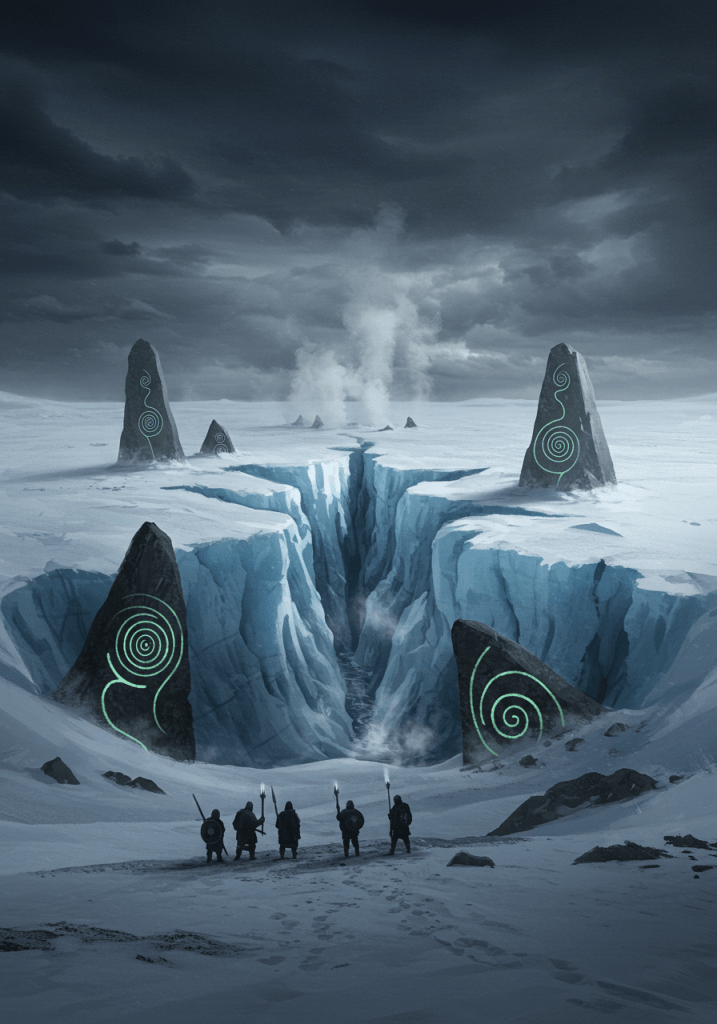
The earthquake came without warning. The ground shuddered beneath our feet, the ice cracking with sounds like the breaking of a thousand shields. For a heartbeat, I feared Jörmungandr himself stirred beneath us, Ragnarök had finally come. But when the shaking stopped, we found ourselves standing before a great rift in the earth, as if Skadi herself had cleaved the ground with her hunting knife.
And there, uncovered by the shifting ice, stood stones unlike any I had seen. Not the rough-hewn markers of my ancestors, but objects of precise geometry, their surfaces bearing markings resembling runes yet were not runes. Looping patterns covered them, branching into configurations that pulled at the eye, shapes writhing when glimpsed from the corner of one’s vision.
“We should go,” said Bagge the Cautious, living up to his name. “This place is not meant for men.”
But I could not leave. The markings called to me, familiar from my dreams yet now manifest in cold stone. While the others argued, I approached the smallest of the stones, no larger than a child’s head, and found I could lift it.
“Put it back,” Hakon commanded, his beard crusted with ice, his eyes wide with uncharacteristic fear. “No good could come of ancient magic.”
“It’s just a stone,” I replied, though I knew it was not. “Perhaps the carvings tell of the land, of explorers who arrived long before us.”
He did not believe me. Nor did I believe myself. But something compelled me to keep the stone, to hide it within my furs when Hakon turned away. The weight of it against my chest brought both comfort and dread.
We found no game, though tracks were everywhere, all fleeing from the rift rather than toward it. We returned with empty hands and hollow bellies, and that night the dreams came stronger than before.
Between my finger and the stone grew a connection as I traced the markings onto scraps of precious vellum. The stone’s patterns differed profoundly from our straight-lined runes; they curved and twisted, sometimes appearing to branch off the page if I stared with unwavering focus.
The settlement sickened as I worked. First the old, then the young. A wasting illness leaving the afflicted babbling of “the cold ones beneath” and drawing spirals in the dirt before death took them. Gytha, the healer, had no remedy. Father Arne, who had come to spread Christ’s word, claimed demons had found us. The father blamed those who still followed the old ways, while they in turn blamed him for angering the true gods.
I alone understood the truth, or fragments of it. The sick spoke phrases I recognized from my translations. “Beneath the corpse of the ice giant,” one woman whispered before her death. “They who dreamed before Ymir’s birth,” a man muttered. These were words I had deciphered just days before they uttered them.
My own dreams shifted. No longer did I merely see the sunken cities; now I walked their streets. Vast structures of slick crystal and bone stretched toward skies filled with unfamiliar stars. Moving among these structures were things never human, colossal beings whose anatomies violated reason. Their limbs folded through themselves, organs exposed yet constantly reshaping.
The food spoiled faster now. Meat slaughtered at dawn turned gray and soft overnight, developing growths casting a sickly, bluish glow in the darkness. Hunger weakened us. And my daughter Freydis began to walk in her sleep.
I followed her on the night of the new moon. She rose from her bed, eyes open yet unseeing, and walked with purpose through the settlement. I should have stopped her, carried her back to safety, but curiosity overcame paternal duty. Was the inscription altering me?
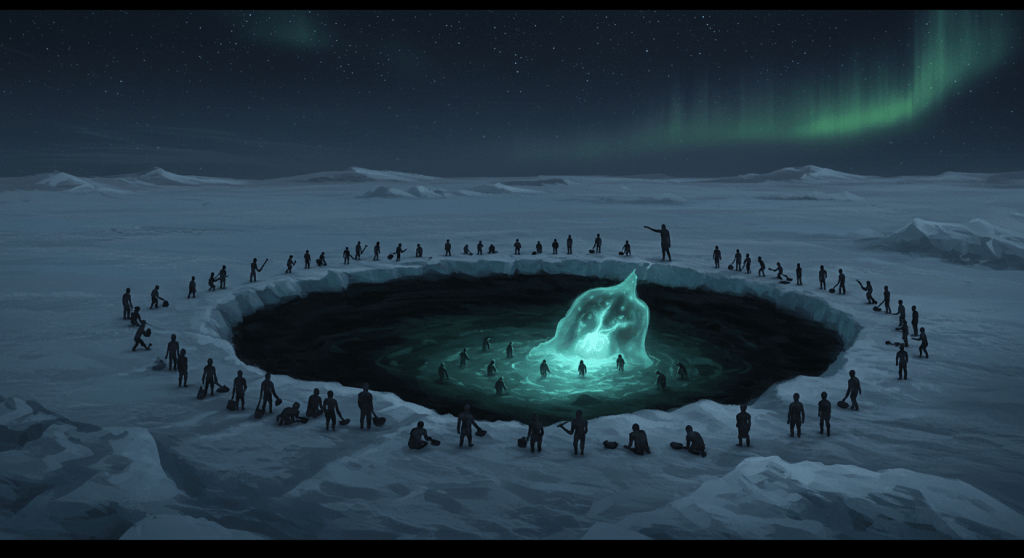
She led me to the rift, now grown wider. The starlight cast strange shadows across the ice, and there I saw not just my daughter but a dozen settlers, all moving with the same eerie precision. Among them stood Malmfrid the Elder, oldest woman in our settlement, who had been too frail to leave her bed for some time. Yet here she stood, directing the others to dig into the frozen earth with tools they must have carried from the settlement.
I hid behind an outcropping of ice and watched. Malmfrid raised her arms toward the stars, and her flesh… shifted. There is no better word for it, though it fails to capture the horror. Her skin rippled like water disturbed by a thrown stone, her limbs elongating, her fingers splitting at the tips. The transformation lasted only moments, but it seared itself into my memory like a hot brand.
When I could bear no more, I rushed forward to claim Freydis. Her skin was cold as the surrounding ice, her breath barely visible in the frigid air. As I carried her back, she began to speak, her words flowing backward, her voice harmonizing with itself in impossible ways.
“The watchers under the ice,” she said, “stir from dreams deeper than death.” By morning, she remembered nothing.
Far from the settlement, in a cave overlooking the merciless sea, lived an ancient völva named Gerd. The Christians feared her, and those who kept to the old ways approached her only in dire need. I went to her with the stone hidden in my pouch and terror in my heart.
Her dwelling reeked of herbs and seal fat. Bones hung from the ceiling; some animal, some not. Her eyes, clouded with age, fixed on me with unnerving precision.
“I expected you, Verse-weaver,” she said before I spoke. “The ice speaks your name.”
I showed her my drawings of the markings. Her gnarled fingers trembled as she traced them.
These signs,” she whispered, “appear in the forbidden verses, the songs we do not sing at midwinter when the darkness is deepest.” She looked up at me, and for an instant, her eyes contained not an old woman but something else peering through her gaze. “They tell of beings swimming in the void before the Nine Worlds formed. Entities to whom the Æsir are mere children.”
“Children?” I asked, my mouth dry.
“Where do you think the All-Father gained his wisdom?” Her laugh was like ice cracking. “Odin hung from Yggdrasil to learn the runes, yes, but the knowledge he sought was not his invention. He stole it, as he stole so many things, from beings far older than gods.”
I thought of my dreams, of the cities beneath the ice. “These beings… they sleep beneath Greenland?”
“Beneath, above, within.” She drew a spiral in the dirt floor. “The giants of ice and fire that songs name are but pale shadows of the true ancients. They neither love nor hate mankind; we are too small for such regard. Like an ant that builds its mound upon a sleeping bear, we exist at their whim, until they wake.”
“They stir now,” Gerd said. “Your people built their settlement without knowing, completing a sequence begun before men first hefted stone axes.” She grabbed my wrist where the first of the markings had appeared on my skin. “You are becoming a bridge, Skald. A doorway.”
I fled from her cave with her laughter chasing me, the stone heavy against my chest. When I returned to the settlement, half our number had vanished. Those who remained moved with an unsettling fluidity, their limbs bending impossibly, their joints rolling beneath their skin like serpents under sand. Their eyes had transformed, tinged with colors not found in nature, pupils contracting into slits when shadows fell across them. None would speak of the missing folk, acting as if they had never existed.
And worst of all, Freydis was gone.
That night, the storm broke over the rift. Lightning of impossible colors forked across the sky, and wind howled with voices almost, but not quite, like those of the missing settlers. I took up my knife, my cloak, and made for the place I knew I would find them.
The grinding sound reached me before I saw it, a vast movement beneath the ice, like mountains shifting in their sleep. Before me, the diggers had cleared a massive pit, a hundred paces across, exposing not earth but something else. A surface, translucent yet not ice, pulsed like the membrane of an eye. Beneath it, slow movement. The missing settlers stood arranged around the pit, my own daughter among them, her face serene, her eyes reflecting lights that had no source.
The light beneath the surface pulsed, and cracks spread through the permafrost. The chanting of the entranced settlers grew louder, their voices overlapping in hideous harmonies. Malmfrid, now unrecognizable as human, conducted their chorus with limbs that split and reformed with each gesture.
I knew then what I must do. Gerd’s words echoed: “Every sacred word contains its unmaking. Every holy shape its opposite.” The translations over which I had labored for weeks—the symmetries I had noted, the inversions possible within each pattern—I must use them, but not as intended.
With my knife, I cut deep into my palms, letting blood flow freely. Through the circle of chanters I pushed toward the center of the pit. The entranced settlers faltered in my intrusion, confused. Pulling Freydis from the circle, I smeared my blood across her forehead in the shape of Ansuz, the rune of Odin.
I plunged my blade deep into the thing directing the mesmerized victims. Black sludge dripped down the handle of the blade, burning my open wound. It shrieked as I inserted the blade again, again, again. The winds that had begun to build up speed shifted, the ground faltered, this was stopping it.
Confusion rippled through the entity. Half the entranced settlers fell into the pit as the ice collapsed, swallowed by darkness and grinding stone. The storm above broke with a sound like the ending of the world, and I clutched Freydis to my chest as wind and ice blasted over us.
When dawn came, the rift had closed itself. The remaining settlers wandered in confusion, no memory of their night’s work. Half our settlement lay in ruins, crushed by falling ice or torn apart by the quaking earth.
Freydis remembered nothing, but her eyes held a shadow that had not been there before. We began to rebuild what we could, making plans to abandon Greenland when spring made the sea-paths navigable again.
But I know the truth. The ancient one merely sleeps again, its awakening postponed, not prevented. My dreams show me other places, different patterns across the northern lands. Here, the ice was coming.
I burned my translations, but it was too late. The runes had marked me as I had studied them. They appeared first as discolorations on my palms, like frostbite that formed symbols rather than spreading across the skin. Now they coil up my forearms, alive somehow, shifting when I do not look at them.
At night, I hear whispers in languages never meant for man. I feel the weight of cosmic eyes upon me. The knowledge I sought has claimed me, as it always claims those who look too deeply into the abyss between worlds.
I leave this account so that others might know. Do not seek what sleeps beneath the ice. Do not complete the patterns. If you see the spiral markings, flee.
The gods themselves are but children playing at the feet of those who dreamed before stars burned, and we are less than motes of dust in their sight.
The runes reach my shoulders now. Soon they will claim my mind entirely.
Toki Sveinsson, Skald, in the Year of Christ, 1028


 C.M. Bell HQ